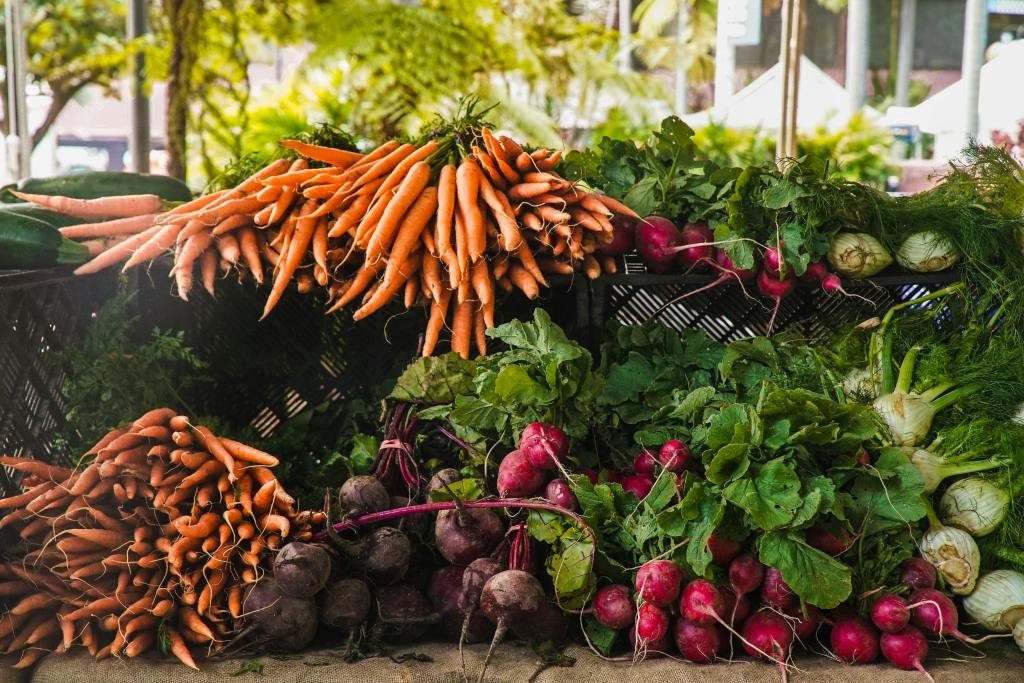
I grew up in California and have long appreciated the variety of produce available to me most of the year.
Since starting this project, I’ve spent even more time at farmer’s markets this year. I love taking the time to wander, chatting with a vendor about how to cook a specific item, getting fresh flowers for my kitchen counter, listening to live music, and relaxing on a bench in the sunshine.
Farmer’s markets can be expensive, although this depends on which one you go to and what you buy and where you’re comparing prices. Is it more expensive than Walmart? Undoubtedly. Whole Foods? Not always. I won’t argue that cost makes the topic of accessibility harder for lots of people.
The reasons for these prices differences could probably be a book on its own, but it seems to mostly come down to an economy of scale and agricultural subsidies.
Economy of scale is a simple(ish) math problem: when companies reach critical mass (of revenue, of employees, etc.), the overall cost of doing business doesn’t exponentially increase with increases in production. So big corporate farms can afford to sell their products at lower prices because they generate more revenue overall. Plus, the little guys tend to invest in more labor-intensive practices, like hand-weeding instead of using pesticides.
The other major impact is the way agricultural subsidies work. The super-short, oversimplified version is the government pays money to keep farms in business and keep prices low for consumers. However, a tiny fraction of farms receive the lion’s share of these benefits.
There are commodity crops (like soybeans, wheat, corn, rice) and specialty crops (almost everything else, from fruits to flowers). Subsidy programs favor the former, but farmer’s markets usually feature way more of the latter. There are some grant programs for speciality crops, but it won’t surprise you to know there’s nowhere near enough to go around.
So with that mega-short lesson in mind, it becomes super important to support farmer’s markets when we can. And luckily here in the Bay Area, there’s a wealth of markets and vendors to choose from!
Farmer’s markets are tasty, but it’s also an opportunity for community. For saying hello to friends and neighbors. For meeting the people who worked to produce the food that nourishes you. There’s something beautiful about the cycle of literal farm to table food, and the hands giving it to you.
I don’t consider myself a foodie by any means, but I’m being 100% sincere when I say the food just tastes better. I always think back to every person who’s ever told me they don’t like tomatoes because they’re tasteless and watery. That’s not how they’re supposed to taste! I remember the tomatoes my parents grew when I was a kid, and although I know a part of me is just chasing the flavor of nostalgia, the only ones that have ever come close are at the farmer’s market.
I’ve noticed my relationship with food is just different when I am regularly shopping at the farmer’s market. I say this with a hefty dose of gratitude that it’s an option for me, but suddenly $10 for a pound of pasta doesn’t feel so absurd when I enjoy the experience of meeting the business owner, trying a new recipe, setting the table, and eating food that tastes great.
Farmer’s markets introduce me to new things (my latest obsession: cultured butter). I get to support small businesses, which in turn supports diverse and sustainable agriculture. I get to interact, however briefly, with a world that’s focused on what is going on in our neighborhood.
And that’s a nice way to spend a fraction of your weekend.
 Buy Bay Area
Leave a comment